Now it is our turn
Agents now reverse engineer closed code for the price of a weekend. The illustrators and the mathematicians got here first. What is dissolving is not a licence. It is the deal that protected skilled work.
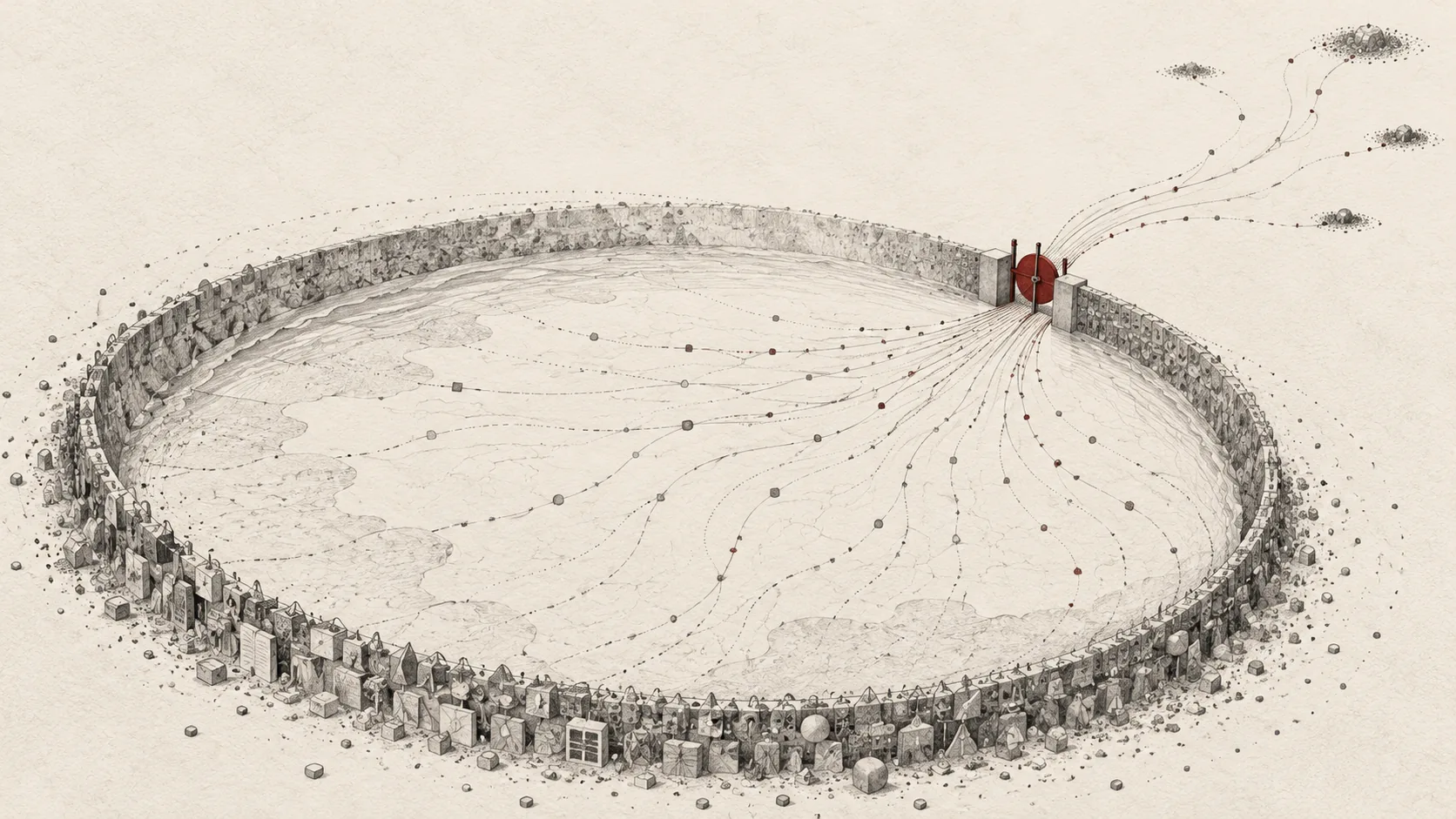
Between 2012 and 2016 I wrote, in Spanish, for a site called United Explanations, and the position in those pieces was not subtle. Software should be free. Information should run free. Stallman was mostly right, Aaron Swartz was right, and intellectual property was a fence the powerful built around things that belonged to everyone. I was in my twenties and I believed it completely.
This month I got what I asked for. I did not like how it arrived.
REA has been at the top of GitHub trending for a week. It is a harness that walks an agent from how an app behaves down to its native binary, and back to source you can edit. ArtCraft is a clean-room, open-source rebuild of most of Adobe's suite, written in Rust by one engineer with Claude doing most of the typing. And Maurice Heumann spent three months and six hundred billion tokens letting agents decompile a first-person shooter until 99% of its functions came back readable. His summary is three words: "Generating code is cheap now."
I posted those links in a Slack channel at work and asked whether this was the end of moats built on closed code. One person said theft. One said trust was dead. One said we were about to find out who owns the GPUs. Nobody was calm, and I recognised the mood, because I had watched other people have it first.
The bill, not the law
Reverse engineering has been legal since Sega v. Accolade in 1992 in the United States and under the Software Directive in Europe. A licence protects the expression of a program, not the understanding of it. Closed code worked as a moat for thirty years because understanding was expensive. Decompiling a serious binary by hand was a career. The licence never stopped anyone. The bill did, and the bill is now a token budget and a free weekend.
So the moat is gone. That is the small story. The large one is who else has stood where we are standing.
Who stood here first
The illustrators stood here in 2022. A model trained on their portfolios could produce their style on request, and the people who had spent twenty years learning to draw were told by engineers like me that this was progress. The rest of us felt bad for an afternoon and went back to shipping.
The mathematicians stood here last month. In September OpenAI put about ten thousand agents on Navier-Stokes, a Millennium problem, and after 88 hours they had a claimed counterexample. Twenty-five Fields Medalists answered with a statement called "A Severe Misalignment of AI in Mathematics". Then OpenAI released 722 more manuscripts in one drop, none peer-reviewed, which the people reading them describe as borderline incomprehensible. Probably correct. Alien.
I watched Tristan Buckmaster, the NYU mathematician whose unpublished work OpenAI is accused of building on, sit on CNBC the morning after the drop. Navier-Stokes was, in his words, the north star of his entire career. He did not look like a man who had been handed a tool. He looked like a man who had been told what he was worth. That is my reading of his face, not his words, and I am keeping it.
Underneath all of it is something older than the technology. For as long as there has been a market, if you were clever, or willing to give up ten years to become very good at something hard, the market treated you a little better than everyone else. Not because capitalism is kind. Because what you had was scarce. A surgeon, an engineer, a mathematician could set terms, could say no. That was the deal, and most of us in software took it without noticing it was a deal.
The deal depended on scarcity, and the scarce thing is now for sale by the token. The kind of intelligence that takes a problem and returns working code, a proof, a contract, a reading of a scan, costs less every quarter and needs no person to operate it. That last part is what is new. Every earlier wave of automation made the skilled person cheaper to employ, so companies employed more of them. A compiler still needed a programmer. A model does not. The radiologist, the lawyer, the chemist, the structural engineer, the translator, all held the same deal for the same reason, and all are watching the same thing happen at slightly different speeds. And nobody has to be malicious for the deal to end. Capital only has to prefer the cheaper input. It never needed so many of us. It needed our scarcity. That is what the thread was mourning under the word theft. Not the code. The deal.
What I asked for
Now the irony, which is why I am writing this at all. The thing finally dissolving intellectual property is not the free software movement. It is four or five of the largest companies on earth, doing it because it serves them, with a tool only they can afford to build. The technique is public. The capacity is not, and capacity is what you get when enough capital sits in few enough hands to spend ten billion dollars on a question. The information is running free. It is running through someone else's meter. Intelligence is a commodity for the people buying it and a cartel for the people selling it, and those are the same five companies. One colleague in the thread said it plainly: this is not liberation, it is a change of landlord.
I have not changed my mind. I still believe in open software and open models, and underneath both in something simpler: a person should be able to expand what they know and who they are without asking anyone's permission. Stallman would say the answer is what it always was, free weights, run it yourself, and he would be right, and it would not be enough, because freedom at the level of the licence does not get you the GPUs.
And I am not against any of this. I use it every day, and a machine that can read every binary and every proof is closer to the world I wanted in 2012 than anything before it. Under capitalism it was always going to be built this way, through accumulation, because nothing else could pay for it. What I am saying is that it is going fast, faster than anyone intended, because five companies are racing each other and none can afford to slow down. The mathematicians did not ask for 722 papers in a day. OpenAI did not need to publish them in a day. It did because someone else might have published first.
I asked the channel whether this was the end of moats built on closed code. The honest answer is that the moat was never the code. A company's moat and a worker's bargaining power are not the same thing, but this month they turned out to be made of the same material: us, and how hard we were to replace. We did not see it when it was the illustrators' turn, because it was not our turn. It is now, and this time we are the ones watching the water go.